A Bubble Waiting to Correct
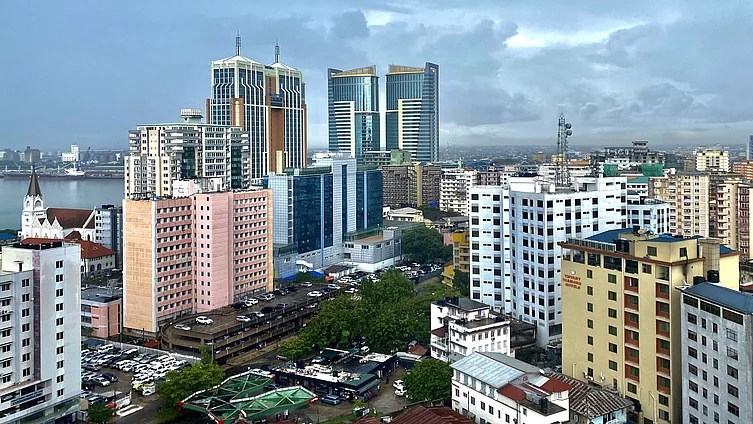
Dar es Salaam’s skyline is changing. Cranes dot the horizon in Masaki, Mikocheni, Kawe, and along Bagamoyo Road. Thousands of apartment units have been completed or are nearing completion, many designed for a buyer earning in dollars—a legacy of late-2010s consumption patterns and Airbnb-driven yield expectations.
But that dollar-earning pool is shrinking. The shilling has adjusted under Bank of Tanzania measures. Expatriate packages are leaner. And the developers who once sold off-plan within weeks now hold completed units for months, quietly slashing prices or offering flexible payment plans that didn’t exist two years ago.
The question is no longer whether Dar es Salaam’s property market is overpriced. It is how far and how fast the correction will go.
The Supply Glut Is Real
Walk through Masaki, Sinza, Mikocheni, or the fringes of the central business district, and the evidence is visible. Thousands of apartment units have entered the market simultaneously. New supply enters the rental market at the same time it enters the sales market. When investors cannot sell a unit, they rent it—pushing more stock onto the rental side, competing with existing landlords for the same tenants.
The signs are already appearing. “To Let” signs lingering longer in Masaki and Victoria Lane. Landlords offering to cover service charges. A growing number of furnished units listed for months.
The short-term rental data confirms the softening. As of mid-2026, average revenue per Airbnb listing in Dar es Salaam had dropped 41% over the previous 12 months, with properties earning approximately TZS 7.5 million annually. The occupancy rate sits at just 16%, and RevPAR (revenue per available room) has fallen 37% year-on-year. More listings, less revenue per listing—the classic signature of oversupply.
The Affordability Ceiling Has Been Breached
The fundamental problem is not just supply. It is that prices have decoupled from local incomes.
Average monthly net salary in Dar es Salaam is approximately TZS 740,000. A 1-bedroom apartment in the city centre rents for an average of TZS 1.57 million per month. A 3-bedroom in the city centre averages TZS 3.6 million. The math simply does not work for the median urban household.
Meanwhile, mortgage credit remains expensive and scarce. The annual mortgage interest rate for a 20-year fixed loan sits at 18.25%. Banks, already cautious after a spate of non-performing loans, are not rushing to finance speculative apartment purchases. The diaspora—long the reliable buyer of last resort—is feeling the squeeze from inflation in host countries and becoming more selective.
The local middle class, whose salaries have not kept pace with the doubling of asking prices since 2018, is priced out. They are waiting on the sidelines or retreating into cheaper rental stock.
The Valuation Gap Is Masking the Problem
Many apartments are sitting on bank balance sheets at values that no longer reflect what a willing buyer will pay. Because valuation professionals still lean on outdated methods that ignore climate risk, energy costs, and real market liquidity, this mispricing has inflated collateral and masked the gradual softening of the market.
When the correction becomes visible, it may appear sudden only because the market refused to measure it gradually.
Rents Are Not a Safe Harbor
If you think rental income will shield landlords while sale prices wobble, the data suggests otherwise. The affordability ceiling matters for rents too. The median urban household cannot afford the rent that would justify the construction cost of a modern apartment. This forces landlords to choose between prolonged vacancy and a lower rent that undermines the investment case.
Over time, the “valuation” of the property based on its income stream would decline. Rents will either stay flat in nominal terms—which, in an inflationary environment, means they are falling in real terms—or they will drift downward explicitly.
The Prime Market Is a Different Story
This is not a uniform crash. The prime market—Oyster Bay, Masaki, the Msasani Peninsula—operates on different dynamics. Prime properties in these areas command monthly rents of $3,500, comfortably exceeding Nairobi’s $3,100 average. The Africa Real Estate Report 2026/27 notes that Tanzania’s market is on a “steady growth trajectory,” with investment activity concentrated in Dar es Salaam, Dodoma, and Zanzibar.
A new $30 million luxury development in Masaki, Divine Serenity, has already sold 41 of its 136 units ahead of its official launch—more than 30% of the project. The developer is even experimenting with a flat pricing model, removing the premiums typically charged for higher floors or sea views, arguing that as Masaki continues to develop, neighbouring buildings may eventually alter those views anyway.
But this is the top of the market. It is not representative of the broader residential segment, where the oversupply is most acute.
What This Means for Investors
A price correction hurts most those who bought recently, near the peak, using high leverage. If your deposit was small and your mortgage large, a 10–15% decline in value wipes out equity fast. Banks will feel the tremor as collateral values soften.
But not everyone loses. A correction is also an overdue re-pricing of urban shelter. For the growing number of young professionals locked out of homeownership, flat or falling prices are a bridge back to possibility.
The structural drivers of long-term demand remain intact. Tanzania’s population continues to grow. Dar es Salaam adds roughly 750,000 residents annually and targets 10 million by 2030. The housing deficit exceeds 200,000 units per year. Major infrastructure projects—the Standard Gauge Railway, port improvements, BRT expansion—are real catalysts.
But the timeline between infrastructure delivery and the employment, wage income, and formal sector absorption that would expand the market for formal housing is measured in years, not months.
For now, the market is in a standoff. Sellers are holding onto peak-era asking prices. Buyers are waiting. And the gap between what a property costs to build and what the market can actually pay is slowly, quietly widening.
The correction is coming. The only question is whether it will be orderly—or whether it will catch everyone by surprise because they refused to see it building.